
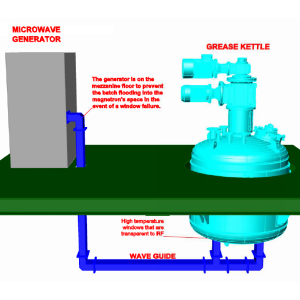
Normally, a grease plant uses a thermal oil circuit to heat and cool jacketed grease kettles and autoclaves. A microwave system, on the other hand, is entirely different. An RF Generator directly heats the batch, using electromagnetic waves, which vibrate the polar molecules in the batch.
THE BENEFITS
Although the ingredients that form the product require the same amount of heat energy, irrespective of the heating method, what you are actually heating is different. The greatest benefit of microwave heating is that it only heat the ingredients. Some of the heat does conduct to the kettle’s shell and agitation, but not enough to be concerning. However, with thermal oil heating, you are also directly heating the heat-transfer oil, pipework, and all the metalwork which holds it. Furthermore, to get the heat transfer, the oil has to be taken to at least 30°C higher in temperature than the batch. The additional energy to do that all that goes to waste.
What are the other standout features of using microwaves that make them attractive? First, you have better control of the batch, by benefitting from the instant application of heat when needed. You cannot achieve this with heat transfer oil because the oil circuit temperature has to increase before the batch temperature increases, making the response to setpoint changes more sluggish than with a microwave system. Second, you have a reduced fire risk because there is no heat oil that is heated to over 200°C, flowing through pipework.
THE THREE POSSIBILITIES
- A new grease plant or section built to use microwave heating.
- Retrofitting Microwave heating to a grease kettle
- Using Microwave heating in addition to the original heating system to increase the heating rate of a grease batch
THE PRACTICALITIES
High powered microwaves can cause safety worries. However, a safely built system includes RF monitoring connected to a cut-off, spark detection in the ullage space, mechanical interlocks, and special pipe connections that will not pass microwaves. Furthermore, microwave energy can be applied to the bottom of the batch to prevent the risk of splashes overheating in the path of the waves.
In terms of retrofitting, microwave heating can be retrofitted to an existing grease kettle by adding ruby windows with flanging for the waveguides. Technically, this is fine, but the conversion cost could be high, so this needs to be calculated in advance.
How can microwave heating can be used to boost a thermal oil system’s heating rate to shorten batch time? The easiest way would be to add a microwave heat exchanger to a pumped batch recirculation line. This would mean that potentially expensive conversion work to the grease kettle can be avoided.
Finally, there are two alternatives for cooling. One is a cooling jacket on the kettle and the other is by using a cooled finishing kettle. The latter would be faster but is more costly and requires the extra space.